
When a buyer writes “pan arrived rusty”, the question is not packaging versus seasoning in the abstract — it is which cause your own return data can actually separate. Rust needs uncovered iron, moisture and oxygen at once, which leaves five places it starts: factory seasoning that missed a rim, packaging that let moisture in, transit or terminal handling, weeks of condensation-heavy storage, or a buyer who washed the pan and put it away wet. The arrival photo tells you where the rust is, not why it is there. Before you rewrite the listing or file a claim, do three things: set the denominator to units sold per lot rather than the return count, build a baseline from your own last twelve months, and check whether cases are scattered across lots or concentrated in one.
Is “Pan Arrived Rusty” a Packaging Problem or a Seasoning Problem?
The question assumes two candidates. There are five, and they overlap, so stop asking which one caused a particular pan and ask which one your evidence can separate. Rust needs three things at once — uncovered iron, moisture, oxygen — and removing any one stops it.
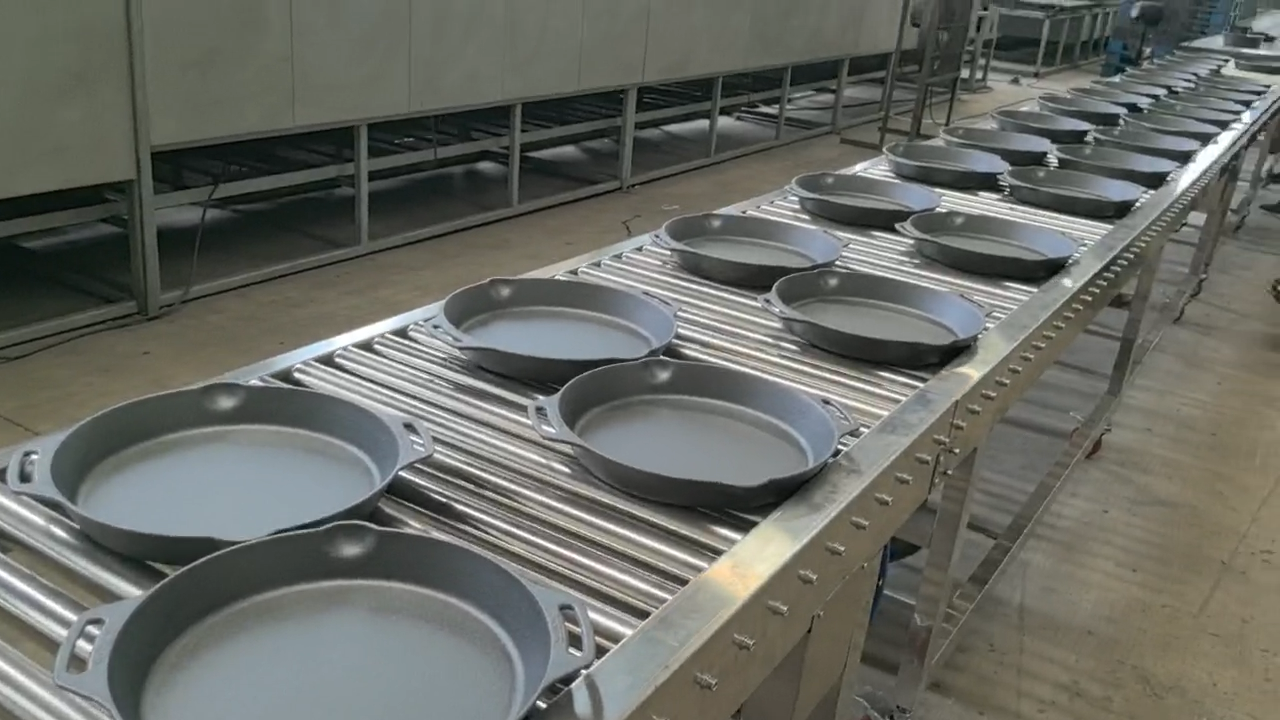
Factory seasoning removes “iron not covered.” On a pre-seasoned pan it is a vegetable oil baked at high heat into a ready-to-use surface (Meiloz pre-seasoned cast iron). It is thin, not enamel, and not continuous by nature: rims, helper-handle edges and pour spouts are where coverage is hardest to hold and where arrival rust usually sits.
Packaging removes moisture — barrier film, desiccant, inhibitor paper, a moisture-resistant liner, pallet wrap. Specified by unit cost rather than voyage profile, these fail quietly: nothing looks wrong at inspection, and the damage surfaces on long humid routes.
Transit handling injects moisture in a single event: a wet pallet, a crushed carton, a port delay. Storage adds cycles. Condensation forms when a cold pan meets warm humid air, so temperature cycling drives it, not calendar age. The buyer adds water by washing and not drying — the cause sellers most want to name and the hardest to prove.
| Where the rust sits | When it appears | Other evidence | Reading |
|---|---|---|---|
| Centre of cooking surface, patchy | After first use | Buyer mentions sticking | Washing and drying, or thin seasoning |
| Rim, handle, exterior, box interior | On arrival | Desiccant saturated, carton soft | Moisture ingress |
| One band or edge | On arrival | Same position across one lot | Seasoning coverage at the factory |
| Whole surface, box water-stained | On arrival | Crushed carton, wet pallet | Transit handling, not the factory |
| Scattered units, any location | Weeks after receipt | Sold late from stored stock | Dwell and condensation |
That sorts one pan, not a problem: a customer is answered, a supplier will ask how often.
What Is the Right Denominator for Rust Returns?
Return count is a numerator, quoted because the dashboard gives you one. Three denominators mislead: total returns mixes failure modes, total orders mixes SKUs, and listing-wide units sold averages away the lots and seasons whose variation you are trying to read.
The denominator that answers a supplier question is units sold from that production lot, per 1,000:
- Numerator: units returned for a rust-related reason und confirmed by photo or comment, not reason code alone.
- Denominator: units sold from the same lot, same window.
- Expression: confirmed rust returns ÷ units sold from the lot × 1,000.
Two refinements keep it honest. On a marketplace the base is units sold, not units received at the fulfillment center; unsold inventory is exposure but not a denominator, so track it as a dwell cohort. And confirmed must mean confirmed — reason codes absorb rust into “item defective” or “changed mind,” so someone has to read the comment text. A rate built on reason codes measures buyer vocabulary, not pan condition.
Then apply a floor on sample size: below a few hundred units per lot, publish counts, not rates. Two returns from 60 units reads as 33 per 1,000 and means nothing. It is a working rule, not a standard, but it blocks the commonest error — a dramatic percentage on a denominator too small to carry it.
How Do You Build a Baseline Before You Blame Anyone?
A baseline is the range your own SKU has always shown. Without one, every return looks like a new problem and every supplier denial sounds plausible.
- Fix the window: twelve months per SKU, or one full seasonal cycle.
- Define the event in writing: which reason codes count, whether a photo is required, who reads comments.
- Tag by rust location: cooking surface, rim and edge, handle, exterior and box interior.
- Join the lot code from carton marking to sale record. No lot code is the first gap to close.
- Compute per 1,000 for every lot, including lots with zero or one return — the empty rows are the comparison.
- Split by month, destination climate, channel and dwell. A winter lot thawing in a warm store is a different exposure from a summer lot into a dry market.
- Set a working band from your own data, not a figure quoted online.
Your median lot is what the current spec delivers on a normal day; your cleanest lot is what it delivers when route, season and storage cooperate. The gap is the value in a packaging change, and it usually exceeds what a claim recovers.
One trap: a rate inside the band is not automatically fine. A band that has drifted up for four quarters means a spec that is marginal everywhere.
How Do You Tell a Scattered Pattern From a Lot Cluster?
Two shapes, two owners. Scattered means returns track sales share — every lot contributes roughly in proportion, and the rate moves with season, destination and dwell rather than production. That points at specification and instructions. Clustered means one lot, production week or container carries a share of returns well above its share of sales. As an illustration: a lot at 8% of quarterly sales and 30% of confirmed rust returns is a cluster; at 8% and 11%, noise.
Run the carton test before calling it a factory issue: affected units from a contiguous block of cartons in one container point to a moisture event there, not a coating problem. Three records separate the owners:
- The lot code names the production run — the factory’s question.
- The container number names the voyage — the forwarder’s question.
- The inbound condition report records what arrived. Dry, intact cartons on receipt plus rusty pans six weeks later do not indict the factory.
Ask four items on every rusty return: a photo of the pan as received, a photo of the box interior, the carton lot code, and one line on whether the buyer washed it first.
What Should You Ask the Factory to Send With Each Lot?
A defensible claim is built from these records; request them before the dispute, not during it.
- Lot code on every carton, with production date and lot volume against it.
- A pre-shipment inspection report showing the packing, not just the pan. Meiloz runs final inspection and issues a report; buyers can arrange third-party inspection (Hersteller von gusseisernem Kochgeschirr). Photos of inner packing materials are what count.
- The written packing specification: carton style, inner protection, barrier bag, desiccant type and quantity, pallet wrap. Most sellers lack it, and no packaging claim is possible without it.
- A sealed retained sample per lot, so a returned pan can be compared with factory condition months later.
- The seasoning record: oil type, application method, cure temperature and time, as a spec sheet rather than a verbal assurance.
- A food-contact compliance statement. Meiloz states that its cookware meets FDA and LFGB food contact safety standards and that its factory is BSCI-certified; in the US, food-contact rules sit under Title 21 of the eCFR. That answers a safety question, says nothing about moisture, and must never close out a rust complaint.
Size desiccant to the carton’s air volume and paper, not a fixed count per box: a carton with a paper insert and one without are not the same load.
What Action Does Each Reading Justify?
Each pattern has one action that fits it; applying the wrong one means rewriting a listing that was fine while a packaging spec quietly fails.
| Reading | What it means | Action that fits | Cost sits with |
|---|---|---|---|
| Scattered, inside band, rises with dwell | Spec marginal across the chain | Change the packaging spec | You |
| Scattered, above band, no lot stands out | Thin seasoning or expectation gap | Spec review plus listing rewrite | Shared |
| Cluster inside one lot | Production or packing event | Claim against the factory | Factory |
| Cluster in one container, several lots | Moisture event in transit | Claim against forwarder or warehouse | Logistics party |
| Rust only in “after first wash” comments | Instructions, not product | Rewrite the listing | You |
| Rate flat per 1,000, count rising | Your denominator grew | Track only | Nobody |
The listing rewrite is the cheapest action and the most often skipped. If a pan must be dried immediately after washing, say so in the bullets, the A+ content and an insert card. A buyer who read that before purchase returns differently, and how to remove rust from a cast iron skillet is a sensible page to point them at, because it addresses the pan they already own.
A factory claim is the most expensive thing to get wrong. Bring affected unit count, lot volume, the retained sample, the inspection report with packing visible, and photos — not a sentence about customers complaining. A supplier cannot investigate a sentiment, and a claim without a denominator invites a polite denial. With 40% deposit and 60% before shipment, pre-shipment inspection is the last cheap moment to disagree.
For a packaging change, specify five things: barrier film on the pan, desiccant sized to the carton’s air and paper, a moisture-resistant liner where the carton meets the pallet, stretch wrap with top sheets, and a storage instruction printed on the carton. E-commerce packaging is not retail shelf packaging; it survives a drop test.
FAQ
Is one rusty pan out of a hundred actually a problem?
Treat it as a count, not a rate. At a hundred units the sample is too small to blame a lot or to compare against any benchmark, so use it as a reason to open the packaging question, not to file a claim.
Can a pan arrive rusty if the factory seasoning is good?
Yes. Seasoning is a barrier, not a seal. Moisture that enters the carton and condenses will rust rims, handles and exterior walls however well the cooking surface is coated.
The buyer already washed and re-seasoned the pan — can I refuse the return?
Treat it as a proof problem, not a refusal decision. The refund usually happens before anyone inspects the pan, so keep supplier recovery as its own file. Record the comment and check where the rust sits: lot or instruction gap?
Does heavier factory seasoning reduce rust returns?
It helps the cooking surface and does little for rim, handle or box interior, where most arrival rust is found. It is no substitute for a moisture barrier, and if it masks edge coverage problems it blurs your lot-level signal.
How long can a pan sit in a humid warehouse before rust shows?
No fixed calendar answer: condensation cycles drive it, not elapsed time. A pan moving from a cold container into a warm humid warehouse can rust within days; one held dry and stable stays clean far longer. Dwell and inbound condition belong in the baseline, not the ship date.
What is the single document to request first?
The written packing specification. Without it you have no basis for a packaging claim and no way to separate a packaging failure from thin seasoning.
If you are specifying pre-seasoned pans for an online channel and want seasoning and packing options before you commit to a lot, start with Meiloz pre-seasoned cast iron.
Source this at Meiloz