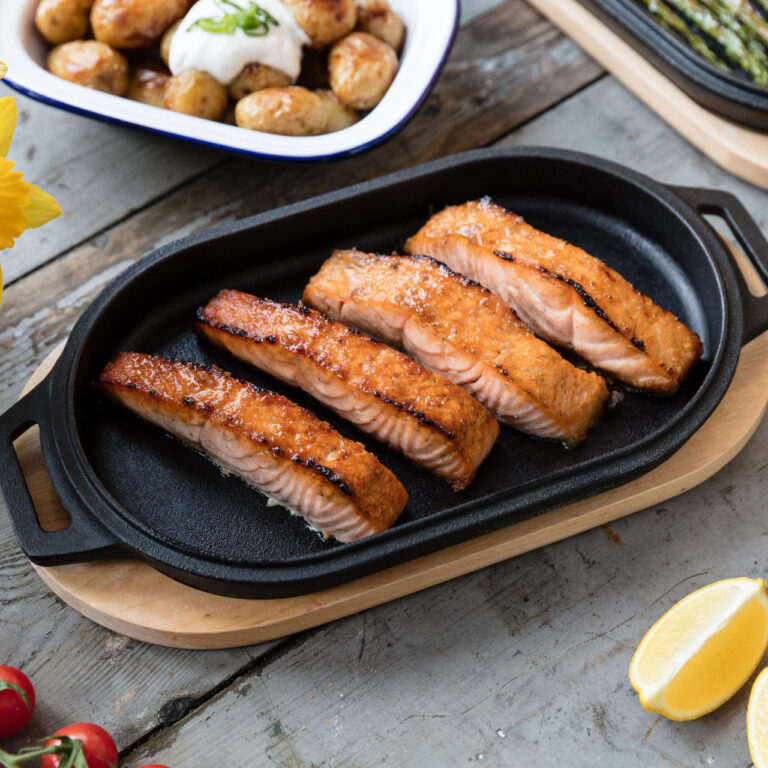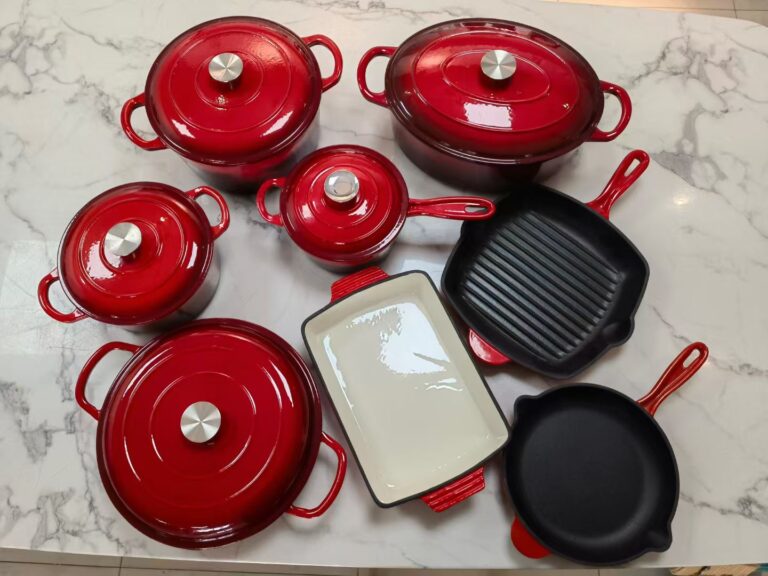
Short answer: put cast iron where a breakfast line needs stored heat and takes mechanical abuse. Bare iron should never enter the dish machine; enameled pieces may, but the number of cycles has to be specified in writing rather than assumed. That means griddle plates, single-portion skillets, enameled Dutch ovens for moist buffet items, and simple presses. It does not mean thin display pans or anything with an uncoated rim that will be stacked wet. Choosing the items takes an afternoon. What decides whether the line still looks right in eighteen months is the procurement layer underneath: how many pieces you hold, what you reject at the loading dock, and what you write into the purchase order.
Which Cast Iron Items Actually Belong on a Breakfast Line?
A hotel breakfast does four things: it sears, it holds, it portions, and it presents. Cast iron earns its place in the first three. In the fourth it earns its place only when the piece is enameled and moved by hand rather than by trolley.
| Item | What it does on the line | Why it survives |
|---|---|---|
| Solid griddle plate or flat-top insert | Pancakes, French toast, hash browns, sausages, grilled sandwiches | Thick section, no coating to chip, scraped and re-oiled rather than washed |
| Single-portion skillets, at the small end of the seasoned range | Baked eggs, shakshuka, individual frittatas, breakfast potatoes | Goes from burner to oven to table without a transfer; deep enough to hold sauce |
| Enameled Dutch ovens, 3 to 6 quarts | Baked beans, stewed fruit, oatmeal, grits, compote | The fired coating tolerates acidic and moist food that would strip seasoning from bare iron |
| Bacon presses and sandwich weights | Made-to-order station only | No coating to chip; the wooden handle is the one joint worth checking, and it is wiped rather than soaked |
| Cornstick or bread-stick pans | Breakfast bread service, cornbread, individual loaves | Heavy section holds oven heat; moulded cavities need no release agent once seasoned |
Sizes come from the product range rather than from a menu guess: seasoned skillets run from 6 to 15 inches, so a portion pan is simply a small one from the same family. Two rules sit behind that table. First, a piece that is washed should be enameled; a piece that is scraped should be bare. Second, enamel is tolerant of the machine but not unlimited: the moment a piece is washed several times a day, its finish becomes a consumable, so the cycle count belongs in the specification instead of in a care leaflet.

Which Items Fail First, and What Actually Kills Them?
Failure on a breakfast line is rarely thermal and almost always chemical or mechanical. Four mechanisms, in the order they show up:
- Alkaline wash plus rinse aid on bare iron. A commercial dish machine strips polymerised seasoning faster than any home sink. Bare iron that goes through the machine comes out grey, then rusts in the rack overnight.
- Thermal shock from a cold rinse. A pan pulled from a 400°F oven into a cool wash chamber, or a hot plate hit with a wet cloth, loads the casting unevenly. Repeated, it shows up as a rock — the pan no longer sits flat.
- Rim and lid-seat chipping on enamel. Chips start where the piece is stacked against another piece, not where it is cooked. A rim chip is also the point where moisture gets under the coating.
- Handle joints and helper handles. The joint collects wash water, and a loose handle turns a usable pan into a reject at the pass.
The manufacturer’s own guidance is a useful boundary marker: Meiloz states that hand-washing is recommended for enameled cast iron and that occasional dish-machine use is safe. That is the honest claim for a domestic machine. A hotel’s cycle is not occasional, which is why the wash requirement belongs in the specification rather than in a care leaflet.
How Many Pieces Should You Hold per Hundred Covers?
Do not set par levels from a supplier’s recommendation, and do not set them from the number of dishes on the menu. Set them from peak covers and turns:
- Peak covers in the busiest breakfast hour. Not the daily total. Buffets do not spread evenly, so take the peak hour from your own cover data rather than averaging the morning.
- Pieces per cover for that item. A baked-egg dish is one piece per order; a shared pan serves several covers per fill, so divide the covers you expect to serve from one pan by the pans you need. Both numbers come from your own service data, not from a supplier’s recommendation.
- Turns per service. How many times one piece can be filled, served, cleared and returned to the line within that hour. A single-portion skillet typically turns once, because it leaves the kitchen with the guest.
- A wash-and-dry buffer. Enough pieces to cover one full wash cycle plus the rack drying time, so the line never waits on the machine.
Par level is then peak demand divided by turns, plus the buffer, plus a short replacement reserve. Write the arithmetic down, because it is also the number that justifies the order quantity when you go to a factory — and the number that makes a tiered MOQ discussion concrete instead of theoretical.
What Should You Check at the Loading Dock?
Six checks, all doable with a flat bench and a bright light in under a minute per piece:
| Check | How | Reject when |
|---|---|---|
| Flatness | Set the pan on a machined bench, press opposite rim points | It rocks, spins, or shows a gap you can see under a straight edge |
| Rim and lid seat | Run a thumb around the rim; sight along it | Any chip, nick, or exposed iron at a seating edge |
| Enamel coverage | Look into the interior corners and under the handles | Bare patches, pinholes, or a matt area inside a gloss field |
| Seasoning coverage on bare iron | Angle the piece to a light source | Dry grey patches, especially at the rim and handle boss |
| Handle attachment | Grip and twist lightly; check the cast-in or riveted joint | Movement, a visible gap, or a sharp edge at the joint |
| Identity | Match carton label, lot code, and the piece itself | Label and carton disagree, or no lot code on either |
Sample across the pallet, not from the top carton. If the first three cartons all pass but a carton from the bottom layer shows rim chips, the problem is packing and stacking, not casting — and that changes who pays for the fix.
What Belongs in the Purchase Order?
The purchase order is where an operational requirement becomes enforceable. Seven clauses carry most of the weight:
- Item and dimension — diameter, depth, capacity, and finished weight, with a tolerance rather than a target.
- Finish — pre-seasoned with a stated oil type, or enameled with a stated colour reference and coverage requirement including rim and lid seat.
- Wash statement — whether the piece is specified for repeated commercial dish-machine cycles, and what the supplier confirms about coating and rim durability under that routine.
- Packing — inner and master carton, corner protection, and the drop requirement for the parcel configuration if any units ship direct.
- Inspection — the final inspection report, plus the buyer’s right to appoint a third party. Meiloz runs a final inspection and issues a report, and accepts third-party inspection arranged by the buyer.
- Lot coding — one code that appears on the piece’s carton, the packing list, and the inspection report, so a failure can be traced to a run.
- Food-contact basis — the statement the supplier will stand behind, alongside the regulation it is written against. In the US that sits under Title 21 of the eCFR; Meiloz states that its cookware meets FDA and LFGB food contact safety standards and that its factory is BSCI-certified.
Surface requirements belong here too. Edge polishing is a standard step at Meiloz, and the radius is worth putting on the drawing: a sharp rim chips in the rack, while an over-rounded one reads soft in the hand at the pass.
What Replacement Cycle Should You Budget?
Budget replacements from measured attrition, not from a supplier’s life claim. Track two things from the first two quarters: how many pieces fail the flatness check, and how many fail the enamel check. Those two numbers behave differently. Flatness failures track thermal practice in your kitchen — they respond to a training change. Enamel chips track handling and stacking — they respond to racks and to how the dish team loads the machine.
Once you have two quarters of data, the budget becomes arithmetic: failures per quarter, multiplied by the unit cost at your order tier, plus the freight share. Group replacement by lot rather than by piece, because a lot that fails early will keep failing, and buying two pieces at a time is how a line ends up with four slightly different pans.
For a category where bare iron and enameled iron sit on the same line, the split is simple: enameled pieces take the acidic menu items and whatever must be washed, bare iron takes the dry heat and the scraping — and only the enameled share is even a candidate for the machine. Confirm the coated surfaces in the enameled cast iron range before the bay plan is signed, and check the seasoned pieces against the cornstick pan if breakfast cornbread service is on the menu.
FAQ
Can I put pre-seasoned cast iron through a hotel dish machine?
It will survive a cycle; it will not survive the routine. Commercial alkaline detergent and rinse aid strip the polymerised layer that makes the pan non-stick and rust-resistant. Treat bare iron as scrape-and-wipe equipment, and reserve the machine for enameled pieces.
Is enameled cast iron really dishwasher-safe?
The manufacturer’s position is that hand-washing is recommended and occasional machine use is safe. A hotel runs hundreds of cycles a year, which is not occasional. Specify the wash routine you actually run, in writing, and let the supplier confirm against it.
How do I compare a 3-quart and a 6-quart Dutch oven for buffet service?
Compare portion yield against lift weight. A 3 to 6 quart enameled Dutch oven weighs roughly 12 to 18 lbs, and the heavier end is a two-hand lift once it is full. For a buffet that is restocked by one person, the smaller vessel with more frequent refills is usually the better ergonomic decision.
What oven rating should I ask for?
Ask for the rating in writing for the specific item. Meiloz states oven-safe up to 500°F on seasoned skillets, seasoned Dutch ovens and enameled casseroles; do not assume the same figure transfers to a different shape, and do not accept a catalogue number without a per-item confirmation.
Should the whole line be one colour?
One enamel colour across the buffet reads intentional and simplifies replacement, because any piece can stand in for any other. If you run two colours, keep the second to a single hero item so a mismatch never appears in service.
How do I keep the line from drifting into mixed vintages?
Catalogue the line by lot, not by purchase date, and replace by lot. Two quarters of attrition data will tell you whether you are replacing faster than you planned; if you are, the cause is usually wash practice or stacking, and a new supplier will not fix either.
If you are specifying a breakfast line for a hotel group, start from the cast iron cookware manufacturer page and send the covers count, the peak-hour menu and the wash routine you actually run.
Source this at Meiloz