
No single certificate settles this, because a cast iron seller ships two packages and usually only one is tested. ISTA 3A is the procedure written for individual parcel shipments up to 150 lb (70 kg), which is the layer your online customer receives. ASTM D5276 is a free-fall drop method a laboratory runs, and it sits inside that sequence rather than replacing it. Three points decide whether a report is worth filing. A drop report describes one exact package — carton, insert, unit count — not a product line, so the box on the report must be the box on your purchase order. When the carton, insert or pack quantity changes, the report stops describing your shipment. And the layer that fails most often on cast iron is the parcel carton, the one factories most often never test.
Which Standard Applies Here: ISTA 3A, ASTM D5276, or Both?
Both can appear in the same test programme, and they answer different questions. ISTA 3A is a distribution-cycle procedure for individual packaged products shipped by parcel, written for packages up to 150 lb (70 kg) moving by air or ground; drops are one element of it, alongside random vibration under a dynamic top load. ASTM D5276 is a laboratory method for the free-fall drop of a loaded shipping container. It defines how the box is dropped — orientation, release, impact surface — not the sequence of hazards a parcel meets on its way to a door.
The claims are not equal. “Tested to ISTA 3A” means a full parcel sequence was run on a described package; “passed a D5276 drop test” can mean one box was dropped, in one orientation, at one height, and nothing else was checked. Only one of those qualifies a parcel network.
Neither name answers the question that decides your listing: a standard tells you how to test a package, not which package to test. Retailer protocols sit on top, and ISTA’s 6 Series reproduces named retailers’ requirements, including the Amazon SIOC and over-boxing programmes, which a general 3A report does not automatically satisfy. Confirm the requirement with the marketplace, not a supplier’s summary.
Why Does a Cast Iron Shipment Need Two Different Packaging Tests?
Because two packages travel to two customers, and they fail differently. The master carton is a bulk object: cartons are stacked on pallets and loaded into the container, held in a warehouse, then broken down at a dock. The parcel carton is the single unit your online buyer opens, and it travels alone through a courier network, taking the impact on whichever corner lands first.
Cast iron makes that expensive. A skillet or Dutch oven is dense, so drop energy arrives at the enamel rim concentrated on a small contact area; a carton adequate for a light item of the same size is not adequate for a pan several times heavier.
| Layer | What it has to survive | What the report must describe |
|---|---|---|
| Master carton | Weeks of stacking compression, load shifts, dock handling, container humidity, carton bulge that undermines the stack | The unitised load: carton grade, stack height, pallet pattern, handling and vibration sequence |
| Parcel carton | Corner and edge drops in a sorting hub, repeated handling, vibration in a van, parcels stacked on top | The configuration for a single unit, its insert, and the drop sequence and heights used |
One package can do both jobs only by design: a retail box engineered as its own shipper must be tested as a shipper, with printing, inserts and hangtag on it — the version your customer photographs when it arrives damaged. A plain master carton protects nothing inside it once opened.
Where Does Cast Iron Packaging Actually Fail?
Damage clusters at the same few points, which is what makes a targeted test worth paying for. On the product: the rim and outer edge of an enameled piece, the handle junction, lid rims and knobs, and pour spout tips. On the package: the first corner to hit the floor, the insert under the pan, and the gap between product and carton wall.
- Corner crush. A crushed corner is the signature of a parcel drop; once it folds, the pan moves inside the box for the rest of the journey.
- Insert collapse. An insert that compresses under a dense pan stops holding it, and a pan that shifts a few centimetres will find the carton wall.
- Contact through the packaging. Too little clearance at the rim, or a retail box with no support behind the print, sends impact straight into the enamel.
- Closure and dunnage. Tape that lifts in humidity, or void fill that settles, leaves the unit loose before the first hub.
- Stacking compression. A master carton that bulges under load loses the clearance that kept units apart, and damage appears with no drop at all.
Most of it can be checked on the packing line: corner clearance, insert fit, closure, and carton condition after a stack stands overnight.
Why Does a Drop Report Stop Covering Your Box When the Box Changes?
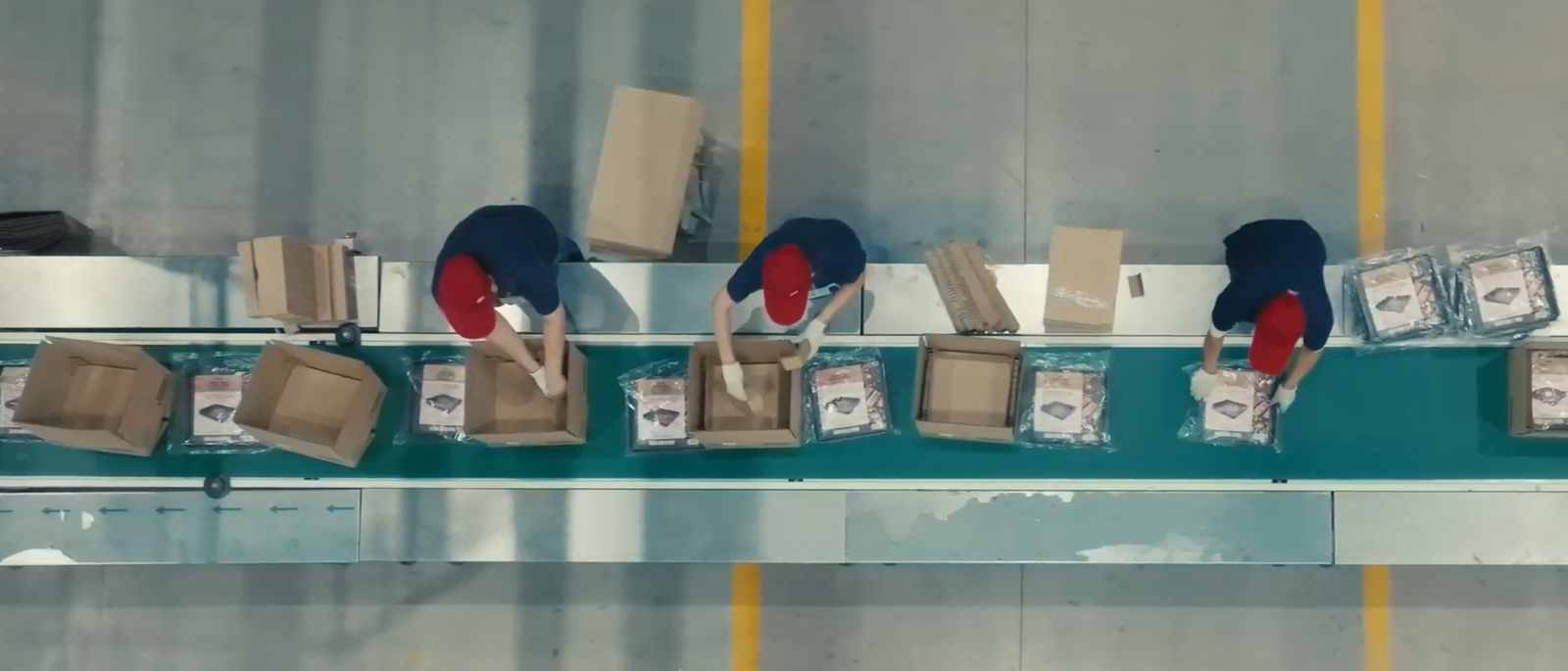
A drop report is written about a sample, and the sample is the whole package, not the pan. A laboratory records carton style and dimensions, board grade, insert material and thickness, units per carton, orientation, closure and the retail packaging. The result belongs to that combination: change one element and the report describes a box you no longer ship.
This is where most packaging evidence dies quietly: the report stays genuine, the laboratory still confirms its number, and the carton in your container is a different object.
| Change | What it does to the report |
|---|---|
| Brown box replaced by a printed colour box, or the reverse | New outer surface, new board, often a new supplier; the tested structure is gone |
| Different unit count per master carton | Changes the load on each carton and the compression the stack applies |
| Moulded pulp insert swapped for foam, or a thickness change | The insert is the impact path; a different one holds the pan differently |
| Added hangtag, sleeve, OPP bag or manual | New mass and new movement inside the same cavity |
| New carton plant or supplier | Board that meets the same grade on paper can behave differently when folded and glued |
| Product change: weight, handle shape, rim thickness, new size | Different mass and contact geometry on the same packaging |
| Different pallet pattern or stack height | Changes the master carton’s compression case and the unitised-layer evidence |
Give the configuration an ID and a revision, put that ID on the carton label and packing list, and require a report against it. When a change is proposed, ask not whether the report is real but whether it still covers the box in front of you.
Who Should Run the Test, and What Must the Report State?
Two decisions: who runs it, and what the document contains. A factory’s own drop test is useful screening, but a self-issued memo carries little weight with a marketplace review or a damage claim. The report you file should come from a packaging laboratory that will confirm its own report number; ISTA publishes procedures and certifies laboratories rather than testing boxes itself, so the laboratory is a separate party to select and pay.
What the report must state, at a minimum:
- Laboratory identity and report number, with a contact who will verify it.
- The procedure and level, not just the standard family: ISTA 3A, or ASTM D5276 with heights, orientations and drop count.
- Conditioning before test: temperature, humidity and duration.
- The package: carton style, internal dimensions, board grade, insert material and thickness, closure, retail packaging inside, and units per carton tested.
- The product: SKU, mass, and the finished configuration that went into the box.
- Pass or fail criteria agreed before the test, including what counts as damage on enamel.
- Photographs before and after each drop, showing the impact orientation.
- Deviations: any run stopped, repeated or hand-modified to complete.
- The configuration ID that also appears on your purchase order and carton label.
A report that says only “passed drop test” is worth little: without a height, a sequence and a package description there is nothing to compare against a damage pattern later.
On the factory side, Meiloz states on its الشركة المصنعة لأواني الطهي المصنوعة من الحديد الزهر page that for online sellers it offers a packaging solution built to pass drop testing. Separately, Meiloz’s cast iron pan manufacturer page states that it will do the final inspection and make the report, or that customers can arrange a third-party inspection. Inspection and drop testing are separate documents: an inspection report can confirm the right carton and insert were used on the day; it cannot confirm that the configuration survives a parcel network.
How Do You Write the Drop-Test Requirement Into the Purchase Order?
The requirement belongs in the order, not an email thread. Packing drifts between orders — a carton supplier changes, an insert is simplified, a colour box is added for a promotion — and each drift invalidates the evidence silently. A clause with an attached packaging specification makes the configuration a controlled document.
| Clause | What to write |
|---|---|
| Configuration | “Packaging configuration ID […], revision […], attached as Annex A: carton style, dimensions, board grade, insert, units per carton, closure and retail packaging. No substitution without written approval.” |
| Test required | “Parcel configuration: drop sequence per ISTA 3A. Master carton: unitised-load handling and compression test per the procedure in Annex A.” |
| Sample source | “Units drawn from a production lot of the SKU and packed on the line, not hand-built for the test.” |
| Laboratory | “Third-party packaging laboratory; report issued in its own name with a verifiable number. Buyer or its agent may attend the test and receive the record and photographs.” |
| Timing | “Report delivered before pre-shipment inspection and before the balance payment falls due.” |
| Re-test trigger | “Any change to Annex A or to the product re-triggers the test. Cost sits with the party that originates the change.” |
| Failure handling | “A failed configuration is not shipped until a corrected one passes. Buyer may reject affected cartons.” |
Book the laboratory early. Meiloz allows one to two days for inspection and testing and advises booking a third party earlier; standard orders run 35–55 days and complex custom designs 45–60, so a test left unbooked at order confirmation lands in the week the container is ready.
For heavier outdoor pieces, which usually ship as a single dense parcel, the rule is the same with less tolerance: the carton is chosen for the product, and the report for the carton. The outdoor and camping gear range shows the formats most often shipped as single heavy parcels.
الأسئلة الشائعة
Is ISTA 3A enough on its own?
For the parcel layer it is the right procedure, but only if the report names your exact configuration and the sequence was run to completion. It says nothing about the palletised master carton, which is a different test object with a different failure mode.
Do I need a new drop test for every order?
No. The test is tied to the configuration and the product, not to the shipment. Re-test when either changes, and keep the report, the packaging specification and the carton label on one configuration ID.
Does a drop test prove the pans cannot break?
No. It shows that a described package survived a defined sequence under stated conditions, on the units sampled — the right evidence for a marketplace review or a damage dispute.
What does a drop report not cover?
Food contact compliance, which is a separate file; compression over a full container load and ocean humidity, which a parcel sequence does not reproduce; and handling outside the tested configuration, such as a carrier’s own over-boxing.
If you are specifying packaging for an online SKU, start from the الشركة المصنعة لأواني الطهي المصنوعة من الحديد الزهر page and ask for the packaging configuration before the sample is made.
Source this at Meiloz