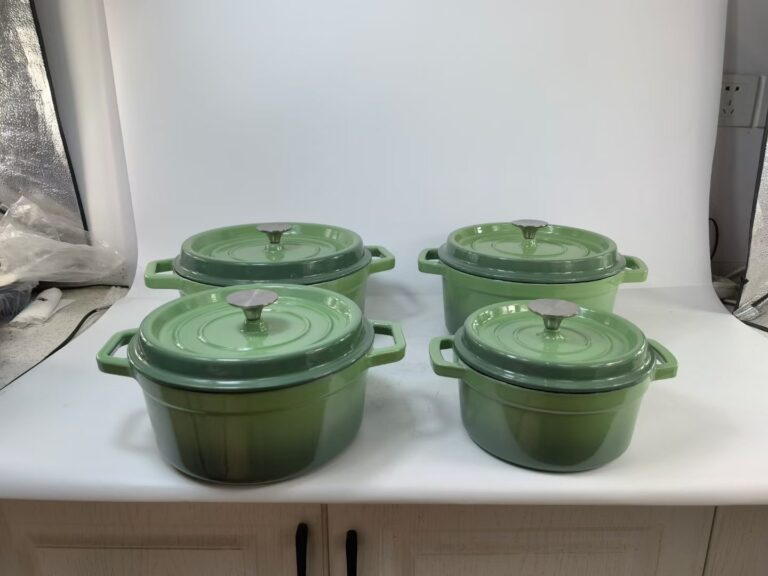
This 2026 guide covers eight cast iron cookware manufacturers and suppliers associated with Germany, plus the sourcing reality that most B2B buyers discover in their first RFQ round: German engineering and German casting are not the same thing. If you are a wholesaler, retailer, or new brand founder evaluating whether to build a cookware line with a German partner, a German brand’s private label programme, or a European-facing factory abroad, this page gives you the shortlist and the comparison columns that matter: MOQ, customisation depth, and certifications.
The German Market in One Honest Paragraph
Germany is one of Europe’s strongest cookware consumer markets and the home of several heritage brands that set the design and quality bar for the rest of the world. It is also a country where domestic cast iron melting is limited: the energy cost structure and labour market mean most enameled and bare cast iron sold under German brands is cast elsewhere in Europe or Asia, even when development, finishing standards, and quality control stay in Germany. Both models are legitimate. Your job as a buyer is to know which one you are paying for, because it changes your MOQ, your lead time, and your tooling budget completely.
Comparison Table: 8 German-Linked Suppliers
| # | Company | HQ / Base | Cast Iron Role | MOQ for B2B | Customisation | Certifications to Request |
|---|---|---|---|---|---|---|
| 1 | Fissler | Idar-Oberstein | Premium cookware maker; some iron lines | Via distributor, not published | Limited; catalog-driven | LFGB, QM documentation on request |
| 2 | WMF | Geislingen an der Steige | Large diversified group; iron in range | Via distributor / retail programme | Catalogue; no OEM | LFGB, social audit on request |
| 3 | Zwilling J.A. Henckels | Solingen | Global premium brand; iron ranges | Retail programme only | Private label not typical | LFGB, internal QC standards |
| 4 | Woll | Bad Kösen | Pans specialist, cast iron and coated lines | Not published | Promotional programs for retailers | LFGB, German site quality |
| 5 | AMT Gastroguss | Heilbad Heiligenstadt | German sand-cast foundry, chef-grade iron | Trade/wholesale account | Engraving, limited custom | German food contact (LFGB) |
| 6 | Stoneline | Bad Kösen | Coating-technology brand incl. iron bodies | Not published | Brand-led, not OEM | Coating test reports |
| 7 | Silit | Herscheid | German pot maker; ceramic and iron ranges | Via distributor | Catalogue | LFGB |
| 8 | Rösle | Bad Hindelang | Premium kitchen tools and cookware | Via distributor | Catalogue | LFGB |
| + | Meiloz (sourcing option for EU brands) | Wuxi / Shandong, China | Cast iron factory since 1996, EU programmes | 500 custom / 1000 regular | Free DFM, moulds from $150, turnkey packaging | FDA + LFGB products, BSCI factory |
The Companies in Detail
1. Fissler
Fissler is a German cookware manufacturer headquartered in Idar-Oberstein with over 240 years of history. It is best known for stainless steel systems, but its catalogues include cast iron skillets and grill pans developed to German food contact standards. Fissler sells to businesses through distribution and retail programmes, not as an OEM partner. If your goal is to stock recognised German quality on shelves, Fissler is a brand partnership conversation. If your goal is to manufacture your own label, it is not.
2. WMF
WMF (Württembergische Metallwarenfabrik) is one of Europe’s largest diversified tableware and kitchen companies, based in Geislingen an der Steige. Its cast iron offering sits inside a very wide catalogue backed by industrial scale quality control. For B2B buyers, WMF means wholesale purchasing of finished branded goods, frequently through national distributors. Customisation is limited to promotional co-branding on selected items.
3. Zwilling J.A. Henckels
Zwilling, founded in Solingen in 1731, is a global premium group whose cast iron ranges (skillets, Dutch ovens, grill pans) are developed in Germany and produced across its manufacturing network. Zwilling’s B2B channel is retail and hospitality supply. The company’s practical relevance to a new brand founder is as a specification benchmark: study Zwilling’s finish, weight, and packaging to understand what European retail expects before you quote any factory.
4. Woll
Woll is a German pan specialist known for coated cookware and cast iron lines, with production at its German site and international operations. Woll works with retailers through promotional and distributor programmes rather than private label manufacturing. Its relevance to this list is the positioning lesson: a focused pan company can compete against heritage groups by owning a narrow category deeply.
5. AMT Gastroguss
AMT Gastroguss is the closest thing on this list to a true German cast iron foundry: sand casting at its Thuringia site, with heavy chef-grade skillets used in professional kitchens. Wholesale access runs through trade accounts. Customisation typically covers handle wood, engraving, and gift packaging rather than new moulds. Expect premium pricing per unit and classic inventory-driven lead times. If your assortment story is “genuine made in Germany cast iron,” this is the supplier to quote.
6. Stoneline
Stoneline is a Bad Kösen based brand built around stone-effect non stick coating technology applied across pans including cast iron bodies. It distributes through retail channels and does not operate as an OEM factory. For buyers, the takeaway is in the coating layer: European retail increasingly expects documented coating safety, so whatever factory you choose, get the coating test reports, not just the iron reports.
7. Silit
Silit, part of the Kaiser/Silit group in Herscheid, has produced pots in Germany for over a century and carries ceramic-coated and cast ranges. Like the other heritage names, its business model is branded goods through distribution. It remains a useful reference point for German mid-premium pricing bands.
8. Rösle
Rösle, based in Bad Hindelang in the Allgäu, makes premium kitchen tools and cookware including cast iron skillets and serving pieces, with design and quality control in Germany. Rösle sells B2B through distribution and hospitality channels. Its range design, especially iron serving ware and grill accessories, is frequently copied, which tells you where European consumer taste is heading.
Plus: The Sourcing Option Most New European Brands Actually Use
None of the eight companies above will make your own brand in a small quantity with your own mould. That job typically goes to a dedicated cast iron factory. Meiloz is one option built for exactly this buyer: a manufacturer with a factory running since 1996 in Shandong and export operations in Wuxi, Jiangsu. Custom MOQ is 500 pieces (1000 for standard items), mould fees are prepaid with two free confirmation samples, small moulds start at $150, and free DFM design review means you can send a drawing and get a producibility opinion before committing. Products are tested to FDA and LFGB (the German/EU food contact standard), the factory holds BSCI, and packaging is turnkey: brown box, colour box, or craft gift box with hang tag, with cast raised logos, laser engraving, or transfer printing. Lead times run roughly 30 days for tooling, 25 to 35 for samples, 35 to 55 for bulk, and ocean freight to Europe is typically 25 to 35 days. Many European brands run a hybrid: heritage German product on the shelf, own-label programme from an LFGB-tested factory. See our Europe solutions page and the manufacturer pillar guide.
Why European Buyers Are Redrawing Their Supply Maps in 2026
Three forces moved in the last two years. First, energy-intensive melting in Europe costs more, which pushes cast iron production toward foundries in Asia and North Africa even for German brands. Second, EU deforestation and due diligence packaging rules mean your carton and wooden handle suppliers now generate paperwork, so turnkey packaging from your cookware factory has real compliance value. Third, retailers tightened audit expectations: BSCI or equivalent social audit is now table stakes for shelf space, and LFGB test reports must name your specific product, not a generic family. The practical result: when you quote any factory for the German market, ask for the LFGB scope document and the current audit certificate in the first email, not after samples.
How to Choose Between a German Brand and a Factory Partner
Use this decision rule. Choose a German heritage supplier when you are a retailer or distributor building assortment with recognised names, and you accept catalogue products, distributor MOQs, and no tooling input. Choose a dedicated factory when you are building your own label, need custom size or geometry, want your logo cast into the iron, and need MOQs a startup can actually fund. A founder comparing 500 piece custom runs against distributor terms of truckload quantities will get very different unit economics from the two paths, and neither result is cheating. Read custom size OEM for what a mould programme includes, and enameled versus seasoned to pick your first two SKUs.
Questions to Put in Your First RFQ Email
Whatever supplier is on the other end of the thread, a disciplined first email saves you two rounds of samples. Ask for these eight items and read the speed and completeness of the response as a data point in itself.
- Quoted price basis: EXW or FOB, and which port, so you can compare landed cost across suppliers honestly.
- MOQ per SKU and whether colours or handle options split the MOQ across separate runs.
- Mould cost itemised by part, plus who owns the mould and where it stays if volumes move.
- Sample policy: cost, who pays freight, and turnaround. A factory with stock samples in hand ships in days; a trader promises weeks.
- Certification documents by name: LFGB report for the exact alloy and coating, plus the current social audit certificate.
- Production lead time split into tooling, sampling, and bulk, with the busy season caveat stated plainly.
- What is included in packaging price: box, insert, hang tag, barcode application, and pallet configuration for EU eur-pallet standards.
- Claim process for transit damage and defect rates, with the warranty window in writing.
A supplier that answers all eight in one reply, within a day or two, is telling you how project management will feel for the next two years. A supplier that answers slowly and vaguely will be slower and vaguer when a container is late.
الأسئلة الشائعة
Is cast iron from German brands actually made in Germany?
Some is, some is not. AMT Gastroguss casts in Germany. Most enameled and bare iron under big brand names is produced in the brand’s international factory network or by contract foundries, with specifications and QC set in Germany. Ask your distributor for the country of origin stamped on the product; EU food contact articles must declare it.
What certifications do I need to sell cast iron cookware in Germany?
LFGB testing for food contact materials is the standard German retailers and importers expect, covering the iron, the seasoning oil, enamel or coating, and any wooden or enameled handle parts. A social compliance audit such as BSCI is increasingly required by retail buying offices. Keep every report current and product-specific.
Can I get German brands to manufacture under my own label?
Generally no. Fissler, WMF, Zwilling, Silit, and Rösle sell branded goods through distribution; they are not OEM factories. Small promotional co-branding exists on selected catalogues. For a true private label programme, quote a dedicated cookware manufacturer.
What is a realistic first order for a new German market brand?
From a European-facing factory, 500 pieces on a custom mould or 1000 on a standard shape is a credible launch lot, with LFGB testing budgeted upfront. From a German distributor, expect case-pallet minimums across branded SKUs instead. Plan 3 to 4 months sample to shelf if tooling exists, 5 to 6 months if you are cutting a new mould.
Get a Quote
If you are building a private label cast iron line for the German or European market, send us your target sizes, quantities, and packaging idea. Meiloz replies within one working day with a DFM opinion, MOQ, tooling cost, and a sample plan, free of charge whether or not you order. Get a quote from Meiloz.